Friday, January 1, 2021
Cashmere, Cashgora, or Algora???
Last year when I discovered that our Alpine dairy goat had not gotten bred to the dairy goat buck I had leased early in the fall, I ended up breeding her with the only other available buck, which happened to be a fine fleeced white angora goat buck. Basically this was a way to bring her into milk; I assumed that the kids would either be adorable fuzzy weed eaters or suitable as dinner/bath rug. When the kids (doe, buck) were born on May 5, I was stunned at how soft and plushy they felt, in addition to being such a beautiful shiny white color. As they grew, they got ever fuzzier and by fall the little doe (Crosstitch) clearly need a trim as she was starting to develop mats and the fiber was about 4 inches long. With the assistance of a friend, I sheared her blanket area and put a coat on her. We combed her legs belly and neck fiber, but left the fiber to help her stay warm. I ended up with about 8 oz of fiber from that feels very soft and silky. The most similar fiber I can compare it to is suri alpaca, or silk. Her brother (Loomis) is similar in fiber type, but the fiber was perhaps 2 inches long in the fall. Using this fiber will be an interesting learning journey.
Friday, June 16, 2017
Muscovy Ducks in Springtime
The ducks start courting and mating as early as February some years. This year the courting got off to an early start because February was exceptionally warm. Courting usually involves the males preening their feathers and strutting around to attract female attention and then splitting off into harems. A relatively cool March and April slowed things down a little, but once May rolled around there were ducks on nests all over the farm. The ducks definitely have different styles in terms of where and how they like to nest, although many of them prefer the area of the rabbit barn because it is more protected and close to where they are fed. The following pictures illustrate different nesting styles.
This duck likes high sides and ground level, but is constantly annoyed when showered by rabbit urine. She tends to look up at the rabbit and make threatening noises, which the rabbit simply ignores. This choice of nesting area perplexes me, but this same duck does the same thing every year.
This duck likes high sides and ground level, and has made a better choice since she is not directly under the rabbits preferred urination area.
This duck has a good view and won't be bothered by rabbit showers, but gets terribly anxious whenever we are feeding or working with the rabbits. She also has to cope with her nest of hay being slowly eaten by the bunnies. When the eggs hatch it is also a long way down for the ducklings (luckily they bounce well).
This duck likes privacy with a ground level view and protection from the elements.
This duck makes a good choice far away from other ducks, rabbits and with a good view.
And of course we now have lots of ducklings wandering around.
Sunday, February 26, 2017
Shearing Day 2017
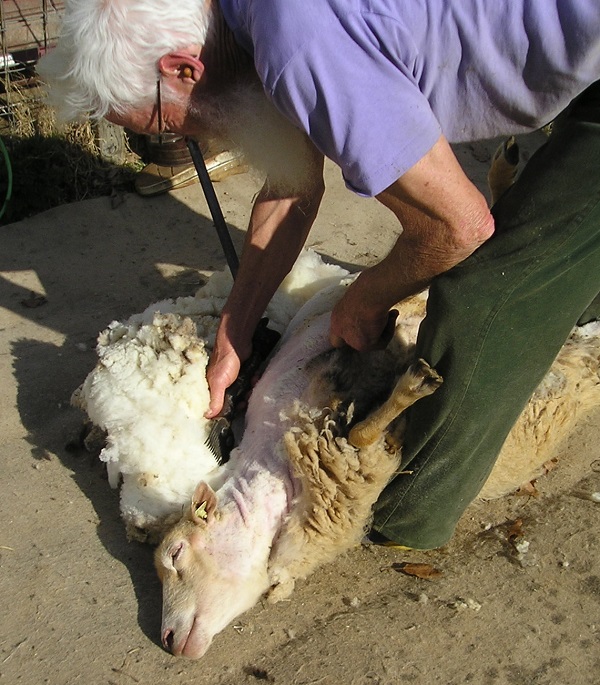
Due to an exceptionally warm February, we were able to get our bred angora does and bred Shetland ewes sheared on Saturday. The angora goats know what is up, and will glare at me as they await shearing their turn.
After we get started they generally relax, and it only takes about 10 minutes or less per goat. The fleeces came off very easily and were exceptionally clean this year.
After shearing we put sheep coats on the goats to help them stay warm. They also have heat lamps in their shelter.
The Shetland ewes tend to be very relaxed about being sheared (once caught that is). This year was very unusual in that all the adult Shetland ewes were already "on the rise." The rise is thought to be caused by changing seasons. During the winter, the wool growth slows down, causing a weak spot in the staple of the wool locks. In the spring, when wool growth resumes, the old wool thins and weakens where the new growth begins. Shetland sheep are best sheared slightly before or just when the rise is starting; shearing must be carefully timed to get the best quality fleeces.
The adult Shetland fleeces already well skirted, but will be given a final skirting before being used in our yarns and rovings, or sold as grease fleece.
The adult Shetland ewes were all snug in their barn this morning. The sheared goats were still wearing their coats. And everyone is looking very well. We'll be shearing last years lambs and kids, plus the Jacob sheep flock later in March and April.
Sunday, April 10, 2016
Lambs at Play
I just love watching the lambs at this time of year. Today we had our last Shetland lamb of the season born. A pretty little gulmoget ewe lamb to Prydwen. Of course the other lambs are just busy at play or else napping on mama. This year's lambs are mostly brown or white with many having gulmoget markings. The only exception being Lessie who had a dark little lamb that I believe will be emsket like her (dusky bluish gray).
Friday, March 11, 2016
First Shetland Lamb of 2016
On Monday, March 7, we went to do morning chores and got a fun surprise. Ceinwen, a white two-year old Shetland ewe, had a new lamb - a white ewe lamb that has among the most curious color markings I have ever seen. She is mainly white, but has one 4 inch black spot along her topline, brown shoulders, and brown stockings. Her mother is pure white with a few stray black spots on her face and her father is a white mirkface called Mojo who comes to us from Rarefind Farm in New Hill, NC. The three colors in one sheep is what makes her unique in my experience. She was a bit of a surprise because, her birth date indicates that the ram must have bred her mother the day he went in. This is unusual for me because typically the ewes are with the ram for a week to 10 days before they start to cycle and settle. Plus because Mojo was a ram lamb, I thought it might take him longer to get started; instead he turned out to be a very fast learner. In the picture below, we have Ceinwen and her lamb with Ceinwen's dam in the picture too.
Saturday, February 27, 2016
Lita Meets the Jacob Sheep
Last year our beloved diary goat Maelita finally had a doe and a buck kid; this is after 2 years of twin buck kids. We named her Lita as she is a smaller version of her mother, being half Nigerian Dwarf. Initially Lita was the soul of quiet politeness. Plus being so petite she is also incredibly cute. When she finally started to really grow, she became short, sturdy and very spunky - so much so that Maelita really did not like sharing quarters with her any longer. Since Maelita is due to kid in a couple of weeks, today we decided that it would be prudent to move her our of Maelita's stall and into the pasture with the Jacob ewes and their lambs - figuring that she would have plenty of company, and energetic lambs for playmates. Lita greeted the Jacob flock by running up to them intent on play, jumping into the air and galloping along sideways. The sheep fled in terror, which is when Lita decided that it would be a fun new game to run after the sheep.
However the Jacob reputation for cleverness is well deserved and they also have relatively low flocking instinct, which made it easy for them to separate out into multiple groups and thus Lita was only able to run after one group at once. Fortunately by evening Lita was finished with the fun and games (at least for now) and was busy eating hay along side a couple of lambs.
Tuesday, February 9, 2016
Spring Comes Slowly
Sir Walter Wally (NC's own groundhog) predicted an early spring. This was confirmed by the famous Pennsylvania groundhog.
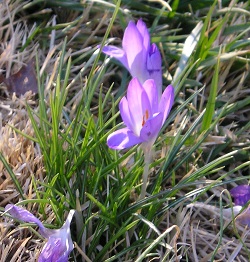
I see signs of spring all around. We've got crocuses.
And dandelions.
And even some daffodils looking like they are getting ready.
And then there are the Jacob lambs. NC028-103 had twins (ewe, ram) early this morning. We're now up to 7 lambs from 4 ewes, with 6 ewes yet to lamb. But it still feels so cold outside and the lows are supposed to be in the 20s for the next few days.
Monday, January 18, 2016
First Lambs of 2016!
NC028-131 (FCS Early) had twins (ewe and ram) in the pre-dawn hours of Monday, January 18, 2016. She is a reliable ewe with very strong maternal instincts and a very nice fleece. I always love the first lambs - gazing into their soft gentle marbled blue-brown eyes, marveling at their tiny hooves; my lovely transcendental lamb moment came to an abrupt end when Early wacked me the thigh to let me know that I had held her baby quite long enough and that she would really prefer me to leave (but not before giving her a treat of course).
Sunday, January 17, 2016
Winter I Can Live With
It is a well known fact that farmers tend to watch the weather obsessively. With the first potential snow of the year forecast for today, I was checking carefully emergency winter weather supplies and checking for the latest weather updates frequently in the last day or so. It looked really impressive when it was coming down.
But by the afternoon it was all gone and the sun was out - definitely my kind of winter weather. Now if it would only stay just a little above freezing at night... that spares me bringing in rabbit bottles overnight and extra watering in bowls. Looks like we are in for some serious freezing over the next few days though so no rest for the weary.
Friday, January 1, 2016
Newest Angora Goat at Avillion Farm
Pictured below is "Ghost Buster" - as in who you gonna' call. He comes from Kid Hollow Farm in VA. I spotted him from 100 feet away at SAFF in Fletcher, NC this year. I've been yearning for a blue buck for several years now - blue being the breeder slang term for white with colored fibers. Right now he looks silvery blue, but he will most likely darken with age. This goat has it all - lovely fiber, nice conformation and a charming personality as well. It was too late to use him this year, other than as a "clean up" buck, but I'm really looking forward to the kids he'll produce in the future.
Tuesday, March 10, 2015
Where They Are Not Supposed To Be
Winter has felt very long this year - even though the worst of it did not
happen until February. Trees are not supposed to be bent over with snow
and blocking the road.
Trees are also not supposed to land on fences, allowing sheep and guardian dog
to escape.
Ducks are also not supposed to be using the rabbit grooming table as a nesting area.
Sunday, April 27, 2014
2014 Weather
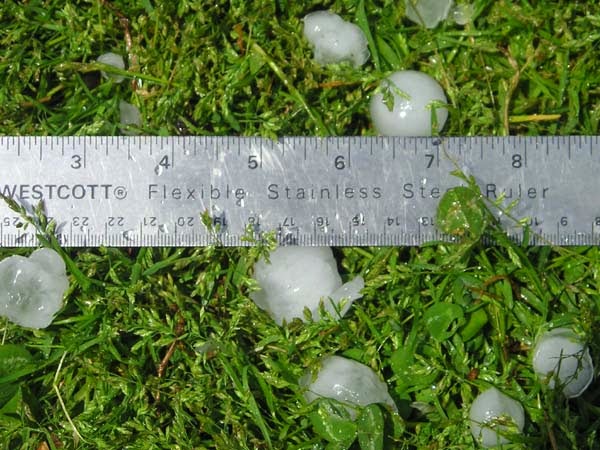
The first third of the year has turned out to be a real challenge weather-wise. A relatively normal January was followed by highly changeable weather in February - featuring a heavy snowfall in the middle of the month. In March, we experienced a late winter ice storm that left much of Orange county an official federal disaster area; I had not seen so many downed trees and debris since the aftermath of hurricane Fran in 1996. We'll be cleaning up from that one for the next year. April's weather event was a hail storm like I had never seen before - large hail stones and lasting about 30 minutes. I wonder what May will bring ...
Monday, February 17, 2014
Sheep That Need No Improvement
Different breeds of sheep are sometimes referred to as "improved" or "unimproved". The term "unimproved" usually refers to sheep that are also called "heritage breeds" or "primitive breeds". Jacob sheep are one such breed and I prefer the term heritage. Basically this means that the breed retains and has been bred to retain its early characteristics, rather than being bred towards one specific purpose and a narrower range of genetic traits. The practical reality is a sheep that is hardy and thrifty with good mothering ability. In the pictures at left and right, respectively are two ewes aged 2 years and 11 years. The two-year-old is a first time lambing ewe that lambed on Feb 2 and the 11-year old lambed Feb 12 (during a particularly nasty winter storm). Both of these ewes lambed easily on pasture and did not need to be put in a mothering pen (meaning much less work for me). This is my kind of sheep and clearly needs no improvement.
Wednesday, February 12, 2014
Sheep in Winter
Sheep seem to just take things in stride. Today (my birthday) we are having an unusual winter storm. It isn't usual to get much snow in the piedmont of North Carolina, and even more unusual to get snow in February. As the weather moved in we were busily putting out extra hay, more bedding in the shelters, and seeing that plenty of unfrozen water is available. All the while, the sheep were busily snacking at their supplement tub (extra energy and minerals because they are within a month of lambing) and eating their hay. They also don't mind the snow nearly as much as I do (note snow on their backs) and will often sleep outside of their shelters during a snow storm.
Wednesday, January 22, 2014
Coping with the Cold
I really am a warm weather person. Now in the depths of January with our second cold snap upon us, spring feels like but a distant hope - a tiny light far off at the end of a tunnel. The sheep, goats and rabbits are all snug in their warm coats, like my buddy Lancaster pictured here. They enjoy the cold weather as evidenced by their spunky energetic behavior. Meanwhile, we are lugging water and my thoughts often stray to the lambs and kids we are expecting in February and hoping for moderate weather when birthing starts.
Then there are the other winter events to cope with, like a burst hydrant. The old one cracked in a really weird place during a brief warm spell. The other casualty was the shovel Gary had to use to dig out the clay and gravel to replace the old hydrant with a new one. Luckily this at least happened when we both had the day off and the broken shovel can join the other tool heads on which we will someday replace the handles. The new hydrant is installed and we'll be able to use it again once the weather warms up a bit.
Sunday, January 5, 2014
Angora Goats Ring in 2014!
The angora goats rang in the new year munching on this year's Christmas
tree (after we'd finished with it).
Because the goats are so efficient, they transformed the Christmas tree into a Christmas twig very quickly (in about 3 days).
Sunday, September 16, 2012
Winter Hay Supply
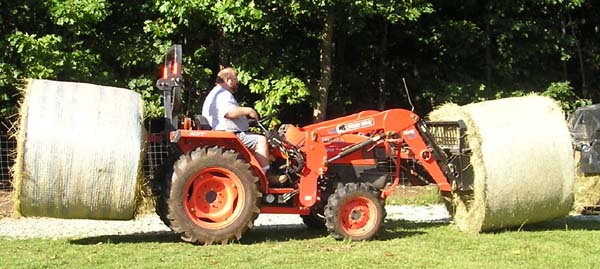
Here is Gary on the tractor moving our winter hay supply so it is arranged in long rows on pallets. We'll cover it with black plastic and tack it down so it stays dry and keeps well until fed to the sheep and goats.
Friday, September 7, 2012
Guess Who's Visiting My Feeder
I put out a bird feeder this year - first for the hummingbirds and then for the bluebirds that are nesting in the bathroom vent and have succeeded in rearing three broods of offspring in a single season (and may be working on a fourth). They looked a little bedraggled so I thought they could use some food nearby. I was very pleased to see the levels of seed in the feeder going down with no squirrels around. Unfortunately, it was the big bird.
Friday, September 23, 2011
Twins in August!
Only a Jacob sheep (actually only this particular one) would pull a stunt like this. Humbug Parsley (one of my spouse's original sheep) lambed with twins on Feb. 2, 2011. She subsequently had another set of twins on Aug. 2 of this year. Basil and Oregano have four- and two-horns, respectively, are wethered and just as cute and friendly as only lambs raised partially on a bottle can be. Parsley is 11 years old now, and did not have much milk after she became ill (now recovered nicely), hence the need for the bottle feeding. If anyone had told me Iwould be feeding bottle lambs in August, I would have laughed at the thought. I am not laughing any more, but the twins do make me smile often. Life here is certainly never dull.
Sunday, July 31, 2011
Ecological Lawn Maintenance

We are still in the phase of establishing truly good pastures, which basically means that the sheep can only be on the new pastures for very brief periods. We were able to use the new pastures for two months during the spring while they were nursing lambs, but otherwise they have been in their drylot being fed hay for much of the year. And then there is the lawn, which we have been having to mow, This property (unlike where I used to live) has lots of lawn. The goats help some (and unlike the sheep will stay around if let out), but they really prefer weeds and brush. This past week we finally got the property fenced off sufficiently to allow the sheep loose for grazing. Hopefully, my lawn mowing days for this year are over.
Subscribe to:
Posts (Atom)